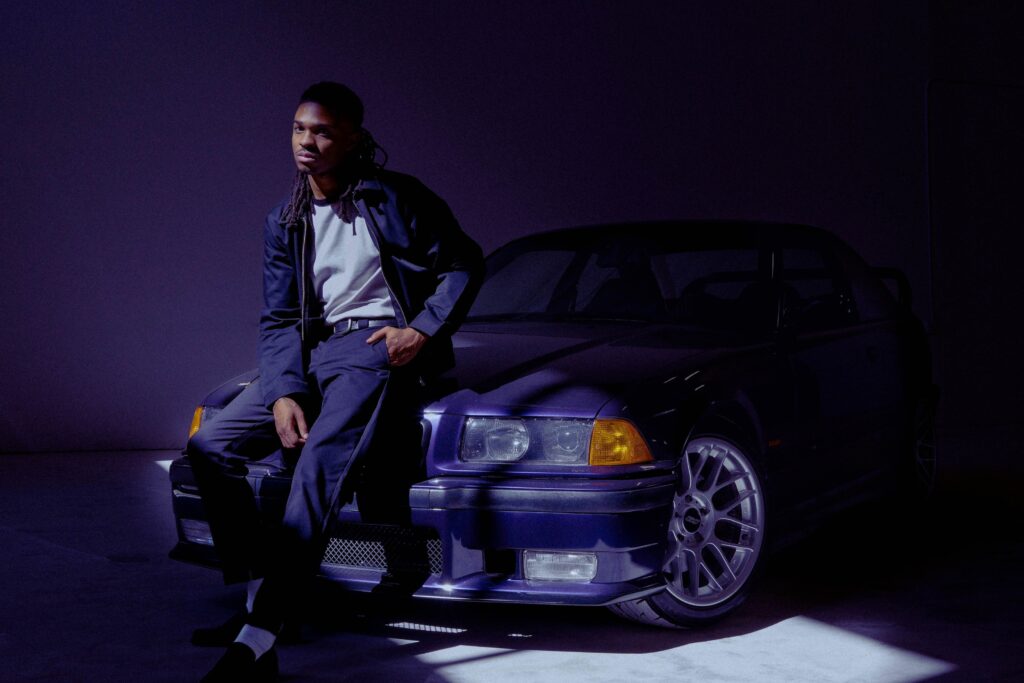
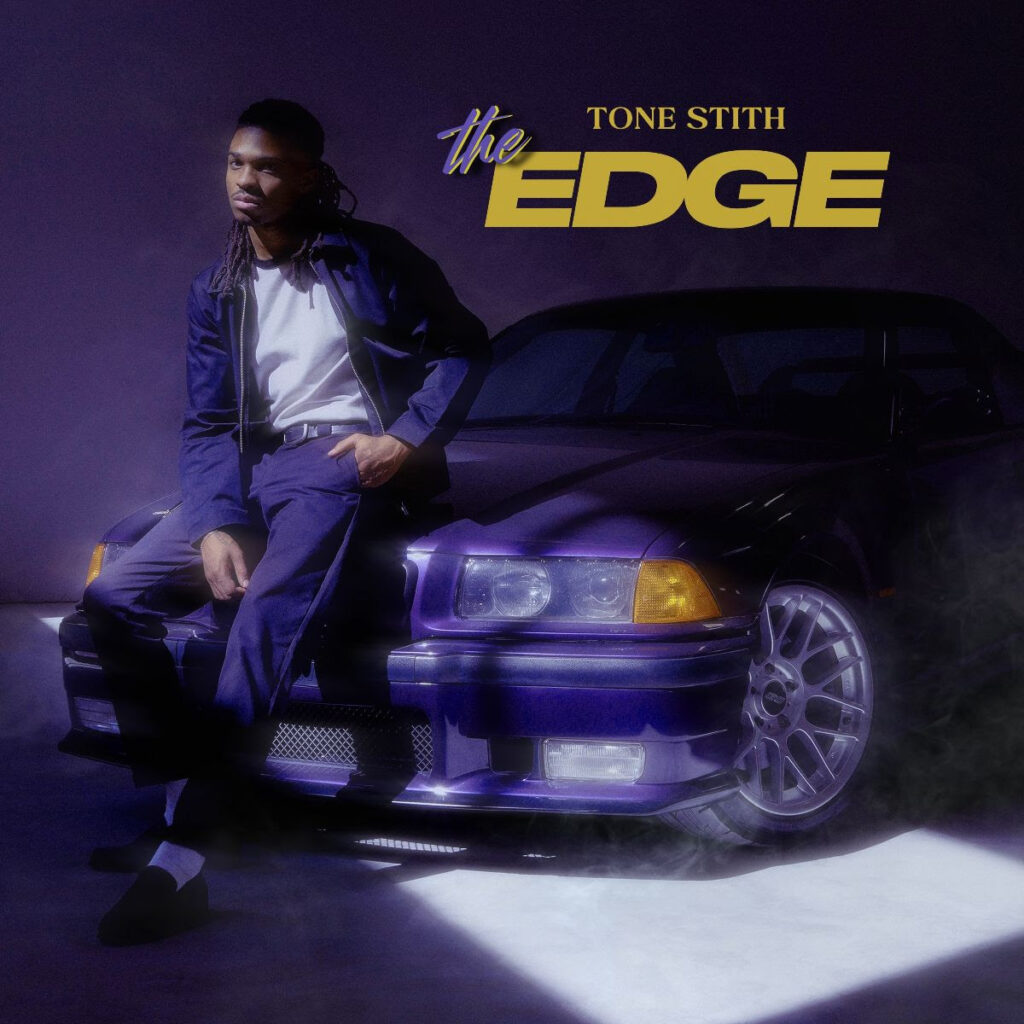
Tone Stith is more prepared than he’s ever been. He’s no longer allowing imposter syndrome to steer him away from what’s meant for him. “This is my leap of faith,” the singer tells Rated R&B, about his debut album, The Edge.
Released May 15 via MRNK Records, the album carries a liberating spirit — one that has lifted Stith’s mind to new heights. “This is a freedom era,” Stith says. “It doesn’t matter the situation — it could be outside of music — if you feel like you’re being oppressed or just in prison, even in your own mind, this is the time to go for whatever it is you want to go for.”
The road leading up to The Edge has been one full of twists and turns in his personal and professional life. Following his 2023 EP P.O.V, he parted ways with RCA Records, where he released three other EPs, including 2018’s Good Company. He also suffered the loss of two people he worked with daily: his manager, Jason Hobdy, in 2024, and his production partner and close collaborator, Melvin Villanueva, in 2025. “I’ve come to realize that life is super short and very unexpected,” Stith reflects. “We aren’t promised tomorrow. You’ve got to live in the moment and enjoy the journey.”
Stith considered that mentality when crafting the album, which he co-produced alongside Brody Brown (Bruno Mars, Adele) and Kenneth “KP” Paige (Eric Bellinger, Keke Palmer). The Edge is 10 tracks, no filler, complete with texture-rich production that swings from the disco dancefloor to the rock-fueled mosh pit. Even when there are pop-leaning elements, it doesn’t stray from his R&B core. Though the album is less than 30 minutes, Stith uses his time wisely to contemplate giving love a chance, trusting his instincts and silencing the noise that comes his way.
How does it feel to finally have your debut album out?
I’m in awe. It feels like I’m in a bird’s-eye view, watching my life right now. I’m taking it all in. I can’t believe this album is actually out. It’s crazy to me.
You’ve been releasing music for about a decade now. How would you compare The Edge to your previous works?
I think I was really living in more of what R&B formed into over the last 10 years. I was in that space a lot. There’s nothing wrong with that because it got me to where I’m at, so I’m grateful. But I need to lay into my roots now — growing up in church and being a musician. I’m playing all on this album, live and producing. I’m an uptempo musical person. A lot of my favorite songs thrive on that tempo. I wasn’t able to display that the way I am now. It’s a different type of soul music and feel I’m going for on this project that I haven’t done yet.
You kicked off the new era with “Shut Up.” What did that record represent for you?
“Shut Up” was special because in the last two years since P.O.V, I was in a space of just living and going through the motions of life — suffering losses, ups and downs, parting ways with my last label and situations. It was a time of a lot of change. I feel like I wasn’t giving my fans the proper perspective of Tone Stith: who I really am and what my artistry really means. Dropping “Shut Up” was important because I got to a point where I was tired of hearing everybody’s opinions. It was my statement song.
When you were going through the motions of life — the personal loss, the label change — how did you stay centered?
I’m religious. I believe in God, and my family is very supportive of that and of me. I was just taking it one step at a time, feeling through the emotions and not trying to suppress them. I had to sit with myself and assess where I was and how I actually felt about a lot of these things and just live with those emotions — grieve and allow the process to process. Now I’m clearheaded, very sure of who I am, and ready to move forward.
You followed up with “Fly,” which is an uplifting anthem at its core. Where did you pull from when making that song?
I think going through life in a more real way gave me a different perspective, like, “OK, my music has to mean something.” It’s about legacy for me. When I’m gone, what’s going to be left behind? “Fly” is the first song where I’m not speaking about love. I’m speaking one hundred percent truth on my story and what I’ve had to overcome in my life. I think it connects to everybody because we’re all on that same path. Everybody wants to spread their wings and take off. Some people are scared and keep themselves trapped. I can relate to that. At a certain point, it was like, “I got to trust my instinct. I know where I come from.”
“Fly” hit No. 1 on Billboard’s Adult R&B Airplay chart. What does this sort of success mean for you at this time?
It’s divine timing, and it gives me that confidence booster to be like, “I’m supposed to be here.” I used to feel imposter syndrome, like, “I’m happy to be here and I’m glad I get to experience this, but do I deserve to be here?” Seeing everything unfold and all the life that has taken place getting me to this point, it’s like, “No, you’re supposed to be here.” And “Fly” being one of the only songs that I really got that raw and just talked about my life and my struggle, for that to be the song that’s No. 1 for three weeks is confirmation.
What’s the meaning behind the title, The Edge?
I named it that because in the last two years, a lot of things have kind of been pushing me to the edge, where it’s like, “Y’all driving me crazy.” The beautiful thing about it is when I got into the industry when I was 18, and was writing songs for Chris [Brown] and doing a bunch of things, it was always a leap of faith. I graduated from high school and moved to LA. I remember telling my parents, “This is what I want to do. I know I was made for this. This is my purpose.” But I think this is full-circle now, being in the industry for so long, and being pushed in different types of ways, but now finding myself, finding my voice and being like, “This is what I want to do, and I’m going to take my leap of faith.”
The Edge is packed with different musical flavors, ranging from R&B, funk, rock and pop. What inspired the sonic direction?
There’s a Mount Rushmore of artists I was pulling from. One of my favorite eras of Michael Jackson is Off the Wall because I felt he was just having fun and that was the most raw album from him. Thriller is then a step-up and then Bad is a step up from that. But I feel like Off the Wall was unpolished. Also, Bruno Mars’ 24K Magic. It was like, “Who’s modern day keeping those same sonics?” That’s what was important to me. I did a lot of studying. I had a small group. It was just three of us who really worked on the whole album. I think all of us understood the goal and wanted to make something edgy, uncut and raw.

Let’s get into some of the newer tracks on the album, starting with “Pageant Stage.” It’s a beautiful ode. What’s the story behind that one?
Me and my homie KP, who’s one of the producers on the album, went to a Kirk Franklin concert that night. He gets a text from Brody Brown, saying, “Pull up to the studio.” So we go in there, chop it up, and tell him about the concert. I guess in the conversation, we’re talking about women, and somebody says, “It’s straight from the pageant stage,” and I just started singing out of nowhere. Brody hopped on the keys, started playing along and we started vibing. KP jumped on the drums. It came together so organically and just clicked.
Lyrically, what was your intent with “Pageant Stage”?
For me, it was just giving women their props. You don’t have to be this top-notch model. You can be the regular woman who works at the post office or a restaurant. It doesn’t matter; you still look like you came straight from the pageant stage.
Midway through the album, you sort of air out your grievances. Aside from what we discussed in “Shut Up,” there’s the rock-tinged “I Quit,” where you also let off some steam. How did that song come about?
I started that song in Miami at the house. I was listening to Pharrell and a lot of Rick James. I just felt this rock-influenced energy. That same day, I spoke to my dad, and we were kind of venting about life, our jobs and everything like that. He was telling me about things he was upset about at his job, and I was telling him things I’m upset about with my career. And that song came to mind. It was just like, “What if I woke up one day and told everybody I’m out? Give me my check, whatever I got left, and I’m gone.”
Why was it important for you to include “I Quit” on your debut album?
Two things. I feel like I never got to really experiment and put something like that out musically. Then I feel like the messaging behind it is very real. We’ve all felt like leaving something, throwing our hands up and saying, “Forget it, I’m out.” Putting that on this album was important because, to me, it’s the most left-of-center of all the other records, but still cohesive. I felt like that one is just in your face, real energy just taking it there.
You haven’t quit music yet, so what keeps you going?
Just knowing I’m here for a reason. I have a purpose. My gift is not for my use only; it’s to serve the people who feel the same way I feel but can’t express it.
Which song on the album challenged you the most?
None of them were challenging. None of them felt like, “Oh, we’re stuck.” Everything really took time. A lot of songs came at certain times organically and just at the right times. The only song we had revisions to get it to the right point was “The Edge.” We just continued to dig. We knew what we had, but it was like, “No, let’s try this. Let’s build on this. OK, we’re getting there. Now it sounds like how it’s supposed to sound.”
Was there anything else that you wanted to add regarding the album?
A possible Edge Tour announcement is coming very soon. I’m just waiting on the OK from the team and getting logistics set up.
Stream Tone Stith’s The Edge here.
Featured Photo Image Credit: Carrington Mitchell